English
 English
 中文简体
中文简体
 Español
 Tiếng Việt
Get in touch
English
Get in touch
Sep 14, 2026
Your supplier just delivered a coil of stainless steel spring wire, and the heat number printed on the coil tag does not match the certificate in your inbox. The wire looks identical to the 304 you processed last month. Maybe it is 316, which would mean a different corrosion performance in the coastal customer's final assembly. How can you tell before you confirm the delivery?
The short answer: you cannot identify 304 or 316 reliably by looking at it, weighing it, or testing it with a magnet. Both are austenitic stainless steels with nearly identical appearance and similar mechanical properties. The one chemical difference that matters most is molybdenum. Type 316 contains 2 to 3 percent molybdenum; 304 contains essentially none. Molybdenum is what gives 316 its superior resistance to chloride pitting and crevice corrosion.
To answer the question with confidence, you need one of three things: original material documentation such as a mill test certificate, a chemical spot test that detects molybdenum, or instrumental analysis such as handheld XRF spectrometry. This guide walks through each path, explains where the conventional tests mislead you, and adds spring-specific context that general stainless steel guides often miss.
Before discussing test methods, it helps to understand why the grade question is not a paperwork formality. Type 304 stainless steel, sometimes written as 18/8 stainless, contains roughly 18 percent chromium and 8 percent nickel. Type 316 contains 16 percent chromium and 10 to 14 percent nickel, plus 2 to 3 percent molybdenum. That molybdenum addition changes the behavior of the passive oxide film that protects the steel.
In clean indoor environments, such as office furniture, kitchen appliances, and interior trim, both grades perform almost identically for decades. The divergence appears when chlorides enter the picture. Salt water, de-icing salt, bleach solution, pickling brine, coastal humidity, and many industrial chemicals all attack the passive layer of 304. The chromium oxide film breaks down locally, forming pits. Once a pit forms, the small anodic area accelerates corrosion underneath the surface. Springs and thin wire are especially sensitive because a pit of only 0.2 mm depth can reduce the load-bearing cross-section dramatically and cause premature fatigue fracture.
Type 316 does not fully solve this problem, because no stainless steel is truly stainless in every environment. But the molybdenum content shifts the balance toward a much longer service life. For example, stainless steel torsion springs on overhead doors near the coast can fail in 304 within a few years, while the same geometry in 316 survives considerably longer. The procurement math matters too: 316 raw material usually costs 30 to 50 percent more than 304. If you order a million springs, choosing the wrong grade in either direction is an expensive mistake that you may not discover until the parts are already in the field.
Let us start with the fastest method: looking at the material. Markings are the only visual evidence that carries real weight. Many stainless steel suppliers stamp the grade on the surface of bars, sheets, and wire spools: "304," "316," "316L," or a heat number that links to a certificate. If you have the spool label or the end tag, record that information and compare it to the delivery documents.
Some manufacturers also use paint dots or colored stripes to mark incoming material. In one common convention, red or red-blue marks identify 304, while yellow, pink, or yellow-black marks identify 316. But these conventions are not universal. Your supplier may use a completely different marking system, and the color can fade or be lost during drawing, rolling, or grinding. Never rely on paint marks as the sole verification method.
What about the surface itself? Many people assume that 316 is slightly darker or that 304 looks brighter. That assumption is unreliable. The appearance of stainless steel depends far more on surface finish, such as 2B, No. 4, mirror polished, or dull drawn, as well as passivation condition, residual drawing oil, and even the angle of light. We have placed 304 and 316 samples side by side in our workshop and watched experienced engineers guess wrong more than half the time.
The spark test, in which the material is ground against a wheel and the spark pattern is observed, is sometimes used in steel yards. It can separate plain carbon steel from chromium stainless, but it cannot separate 304 from 316. Their spark signatures are too similar. The same limitation applies to the scratch test and the file test, because the hardness and scratch resistance of 304 and 316 are nearly identical. Visual inspection is useful for finding markings and detecting gross defects, but it cannot prove the grade.
The magnet test is the most popular field method, and the least conclusive for austenitic stainless steel. Here is the technical reason.
Type 304 and type 316 are austenitic grades, which in theory have a non-magnetic structure. A piece of annealed 304 plate usually does not stick to a refrigerator magnet. But the theory assumes a fully annealed, equiaxed microstructure. As soon as you cold-work stainless steel, drawing it into wire, bending it, or coiling it into a spring, some of the austenite transforms into martensite. Martensite is magnetic.
Spring wire is always cold-drawn, and spring coiling is a severe cold-forming process. It is common to see a strong magnetic response from a finished 316 spring. We have used a neodymium magnet on freshly coiled 316 torsion springs and watched them pin to the magnet like carbon steel. The same magnet on an annealed 316 sheet from the same melt would barely hold. The martensite transformation rate is influenced by composition and temperature, and in some cases 304 transforms more readily than 316, while in others the molybdenum in 316 changes the stacking fault energy and shifts the transformation kinetics. The practical result is that the magnet test cannot distinguish 304 from 316 in drawn wire or formed springs.
| Material condition | Typical magnet behavior | What it means |
|---|---|---|
| Annealed 304 sheet or bar | Non-magnetic | No grade signal |
| Annealed 316 sheet or bar | Non-magnetic | No grade signal |
| Cold-drawn 304 wire | Slightly to strongly magnetic | Grade cannot be concluded |
| Cold-drawn 316 wire | Slightly to strongly magnetic | Grade cannot be concluded |
| Coiled 304 spring | Magnetic on surface | Grade cannot be concluded |
| Coiled 316 spring | Magnetic on surface | Grade cannot be concluded |
| Ferritic grade 430 spring | Magnetic at all times | This is not 304 or 316 |
The last row in the table is worth remembering. If you find a stainless steel spring that is magnetic in its as-received, un-deformed condition, it may be a ferritic or martensitic grade such as 430, 420, or 410. Those grades are cheap, hardenable, and not equivalent to 304 or 316 in corrosion resistance. A magnet can separate 300-series austenitic from 400-series ferritic or martensitic stainless, but it cannot separate 304 from 316.
Chemical spot tests examine the composition of the material directly, which gives them far more value than a magnet. The most useful spot test for the 304 versus 316 question is the molybdenum spot test. The test solution contains a molybdenum-sensitive reagent in an acid medium. When applied to a clean metal surface, it reacts with molybdenum and produces a characteristic color change.
Different test kits use different reagents, so always read the color chart supplied with the specific product. The reaction is qualitative; it tells you that molybdenum is present or absent, not the exact percentage. It also cannot differentiate 316 from 316L, because both contain similar molybdenum levels. If you need to verify the low-carbon variant, request the documentation or use XRF.
Safety comes first. These reagents contain strong acids. Wear splash goggles, nitrile gloves, and protective clothing. Work in a ventilated area. Dispose of used reagent as chemical waste, not as general shop scrap.
One caution for spring applications: the test surface should represent the base material, not a processed surface. A spring that has been heated, passivated, or contaminated with heavy oil residue could give a false reading. Test the raw wire end before coiling, or test a scrap piece from the same batch. This is the method our quality team uses for quick incoming checks when a new coil arrives without a certificate.
If you need certainty, carry a handheld XRF analyzer to the material and hold it against the surface. X-ray fluorescence spectrometry measures the intensity of characteristic X-rays emitted by the elements in the steel and returns a chemical composition readout in seconds. Modern analyzers can be operated by technicians after a short training session, and the readings are accurate enough to separate 304, 304L, 316, 316L, and other grades.
Here is what a typical reading looks like. For 304, you expect 18.0 to 20.0 percent chromium and 8.0 to 10.5 percent nickel, with molybdenum below 0.5 percent, usually close to zero. For 316, you expect 16.0 to 18.0 percent chromium, 10.0 to 14.0 percent nickel, and 2.0 to 3.0 percent molybdenum. If molybdenum reads 2.3 percent and chromium reads 16.8 percent, the material is 316 or 316L. If molybdenum reads 0.1 percent and chromium reads 19.2 percent, the material is 304.
An XRF analyzer costs between $15,000 and $45,000 depending on brand and capability. If you do not have one, several practical options exist: hire an on-site PMI testing contractor, send a sample to a materials testing laboratory, or ask your supplier's quality control department to perform the test and share the signed report. In our own factory, every incoming stainless steel wire reel goes through an XRF check before it enters the spring coiling process. The check takes less than one minute per location and has prevented more than one material mix-up.
The main limitation of XRF is surface condition. Dirt, scale, oil, or coatings absorb the fluorescence signal and produce inaccurate readings. Clean the surface with a wire brush or sandpaper down to bright metal before measuring. Do not test through a painted, plated, or heavily oxidized surface. For very thin foil or thin-walled tubing, the substrate can affect the result, so note the measurement depth and adjust the interpretation accordingly.
Now let us compare the two grades systematically. The tables below give the nominal composition limits and typical mechanical properties relevant for spring design.
| Element (wt%) | 304 | 316 |
|---|---|---|
| Chromium | 18.0 - 20.0 | 16.0 - 18.0 |
| Nickel | 8.0 - 10.5 | 10.0 - 14.0 |
| Molybdenum | Not specified | 2.0 - 3.0 |
| Carbon, max | 0.08 | 0.08 |
| Manganese, max | 2.0 | 2.0 |
| Silicon, max | 0.75 | 0.75 |
| Phosphorus, max | 0.045 | 0.045 |
| Sulfur, max | 0.030 | 0.030 |
| Property | 304 | 316 |
|---|---|---|
| Tensile strength, min | 515 MPa | 515 MPa |
| Yield strength, min | 205 MPa | 205 MPa |
| Elongation, min | 40% | 40% |
| Hardness, Brinell max | 201 | 217 |
| Modulus of elasticity | 193 GPa | 193 GPa |
| Density | 8.0 g/cm3 | 8.0 g/cm3 |
| Melting range | 1400 - 1450 C | 1370 - 1400 C |
Notice that the annealed strength values are nearly identical. For spring design, both grades deliver similar spring rates and load capacity when you compare wire of the same diameter and tensile condition. The grade choice therefore rarely changes the spring rate; it changes the corrosion life and the price.
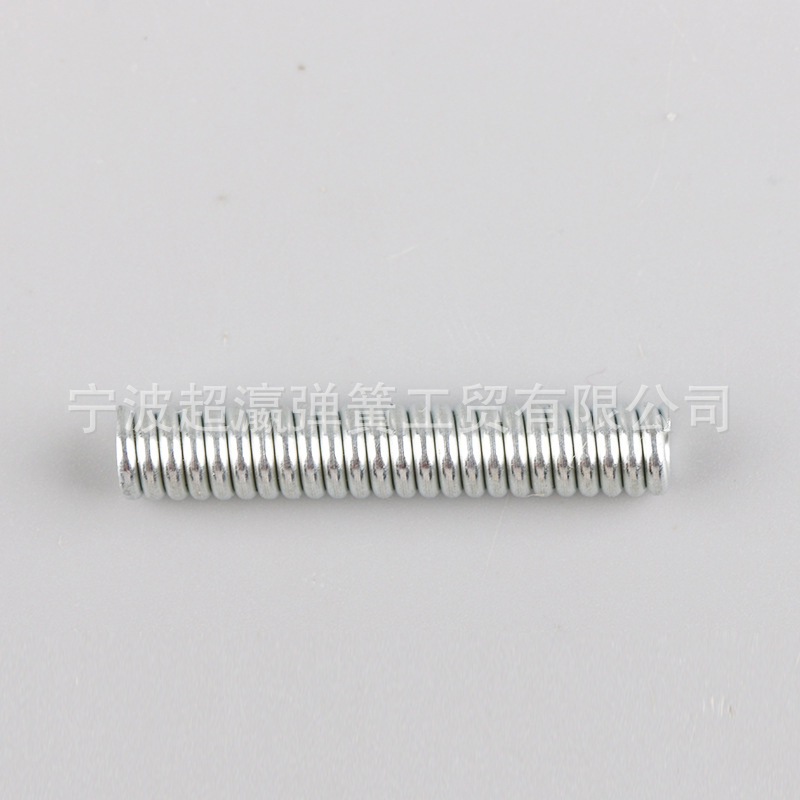
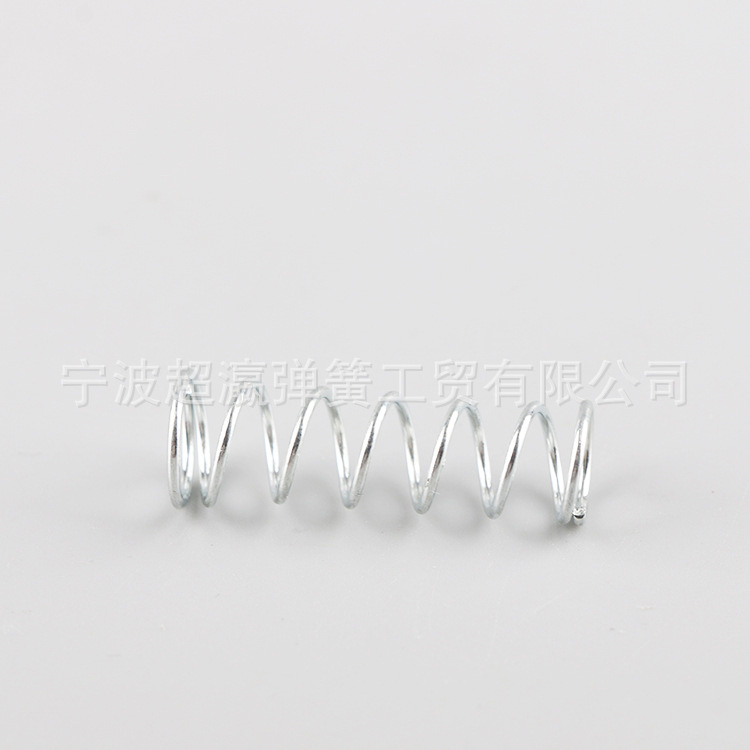 Custom Stainless Steel Compression Spring with Corrosion ResistanceThis spring offers adjustable outer diameter, inner diameter, and free height, making it suitable for diverse applications where reliable force and corrosion resistance are needed.View Product →
The practical message for engineers and buyers: if your specification calls for 304 and the supplier offers 316 as an upgrade, the spring dimensions and rates will be close. The supplier is not changing the performance envelope much in terms of force; the real differences are cost and chloride resistance. Conversely, substituting 304 in a 316 specification to cut cost will visibly weaken corrosion resistance in aggressive environments.
Pitting Resistance Equivalent Number, or PREN, is a formula used to compare the pitting resistance of stainless steel grades. The common expression is PREN = Cr + 3.3Mo + 16N. Using nominal compositions, 304 has a PREN of about 19, while 316 has a PREN of about 26. That single number explains why 316 is preferred in marine hardware, coastal architecture, pharmaceutical washdown areas, and food plants that handle saline solutions.
Pitting Resistance Equivalent Number (PREN)
The difference becomes visible in long-term exposure. A 304 compression spring in a saltwater environment may show the first pits after six to twelve months. A 316 spring in the same location may remain intact for several years. The difference is even more pronounced at elevated temperatures, because chloride-induced stress corrosion cracking accelerates above roughly 60 degrees Celsius. That is why 316 is often specified for springs inside valves, steam traps, and chemical dosing equipment operating outdoors or in process plants.
However, 316 is not the answer to every corrosion problem. In warm, sluggish seawater with tight crevices, such as under a clip or between the coils of a fully compressed spring, 316 can still pit and suffer crevice corrosion. For extreme chloride service, spring designers turn to super-austenitic or duplex grades. For most coastal and industrial environments, though, 316 represents a robust and reasonably priced compromise.
For a deeper look at how the two grades behave in fatigue and surface treatment, read our earlier analysis of 304 vs 316 performance in industrial spring applications. That article covers salt spray test behavior, stress corrosion cracking, and practical recommendations for spring manufacturers.
Overhead doors in coastal towns are a classic 316 application. The torsion spring above the door sees humidity, salt-laden wind, and temperature swings. In 304, surface rust and pitting can appear within a few seasons. In 316, the same spring typically stays clean for many more years, which is why manufacturers serving coastal markets usually specify a stainless steel torsion spring for overhead doors with various specifications.
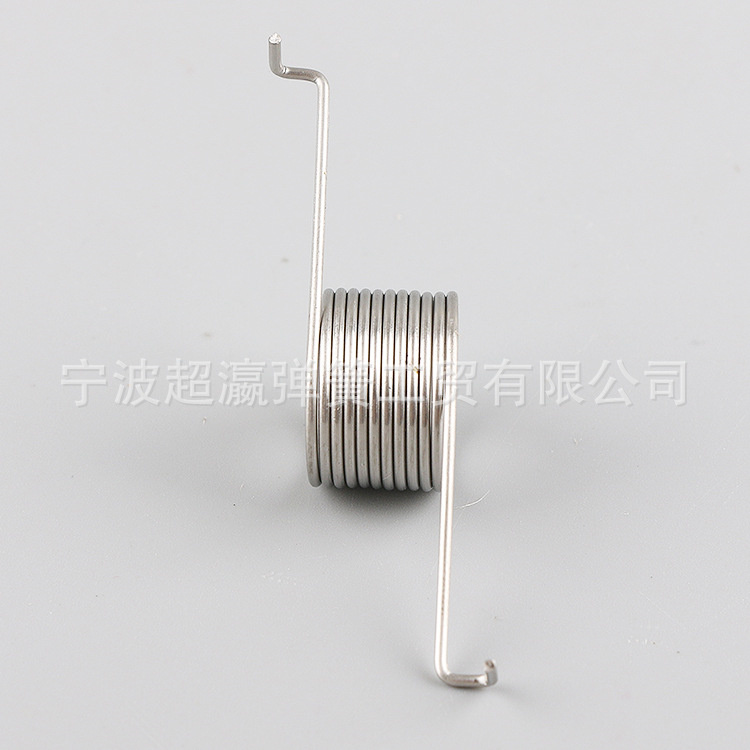
 Stainless Steel Torsion Spring for Overhead DoorsDesigned for coastal environments, this torsion spring resists salt and humidity better than standard options, making it a practical choice for door systems exposed to harsh weather.View Product →
Spring manufacturing adds another layer to the grade decision. Both 304 and 316 wire can be formed into high-quality springs, but they behave slightly differently during drawing, coiling, and stress relief. Understanding those differences helps you avoid surprises in production.
First, work hardening. Type 316 has a higher work-hardening rate than 304 in many drawing and forming conditions. This means the wire becomes stronger as it is cold-drawn and coiled. Spring makers account for this by adjusting coiling speed, tooling angles, and stress relief parameters. If you replace 304 wire with 316 wire on the same coiler without adjusting the setup, you will likely see different springback and a slightly different free length. The spring diameter and pitch may also shift by a small but measurable amount.
Second, the presence of molybdenum affects the heat treatment response. Austenitic grades do not harden by heat treatment the way carbon steel does, but they do need a low-temperature stress relief after coiling, typically around 300 degrees Celsius for 20 to 40 minutes. Type 316 tolerates a slightly wider stress relief window and tends to retain its corrosion resistance better if the time at temperature is prolonged. Overheating either grade above 450 degrees Celsius risks sensitization, where chromium carbides precipitate at the grain boundaries and reduce corrosion resistance near heavily formed areas.
Third, passivation behavior. A properly passivated 316 surface hides fewer embedded iron particles and forms a more stable passive film than 304 in chloride service. If you order springs for food or pharmaceutical equipment, specify passivation after coiling and verify the result with a free-iron test. In our experience, 316 usually passes that test with fewer rework cycles than 304, because the alloy's molybdenum-rich oxide layer heals faster.
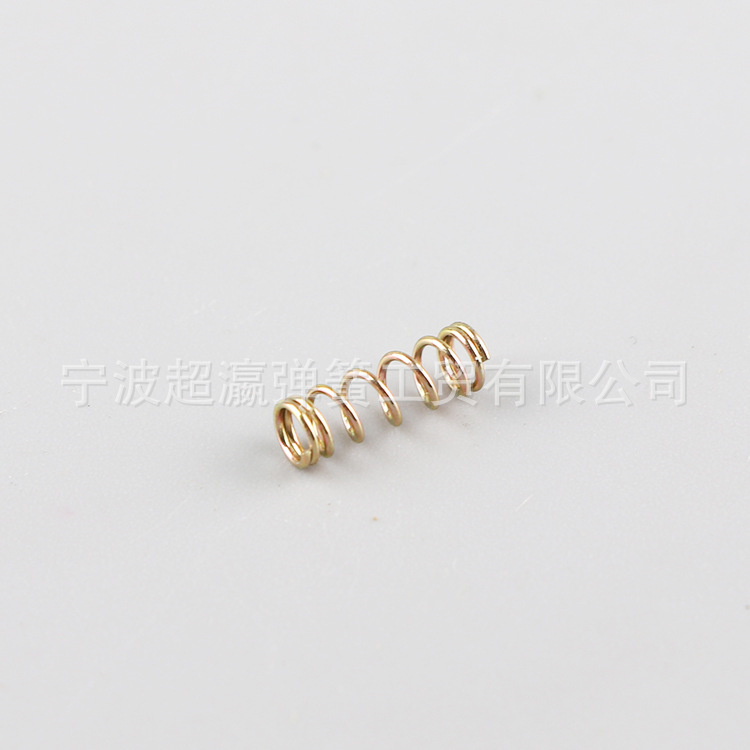
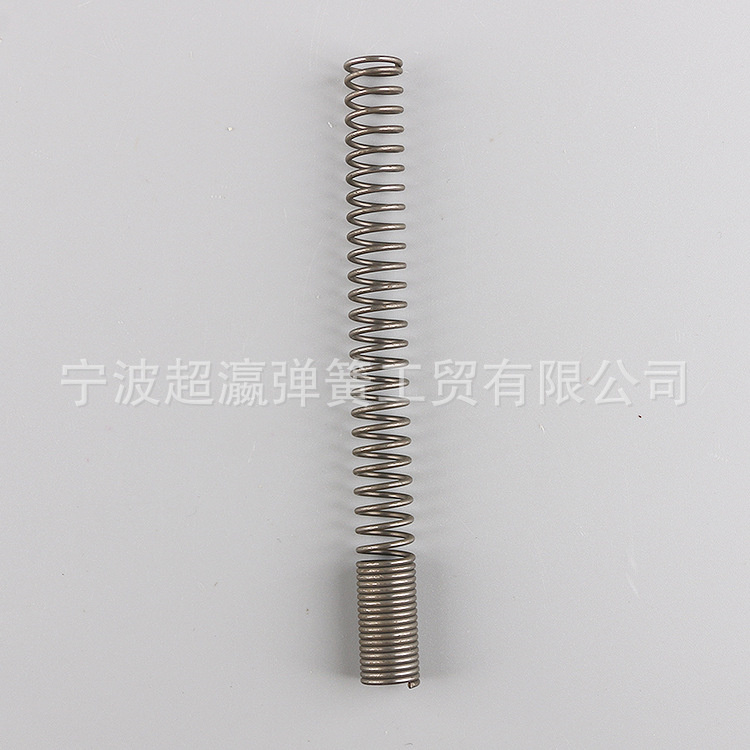
Where does each grade fit in a spring portfolio? Type 304 springs are the workhorse of interior products: switch mechanisms, handle buttons, battery contacts, pen springs, small latches, and appliance return springs. These applications operate in dry or mildly humid environments where chloride exposure is minimal. A stainless steel 304 spring return pressure small spring, for example, gives dependable cycling in a valve or button assembly for years without any visible corrosion.
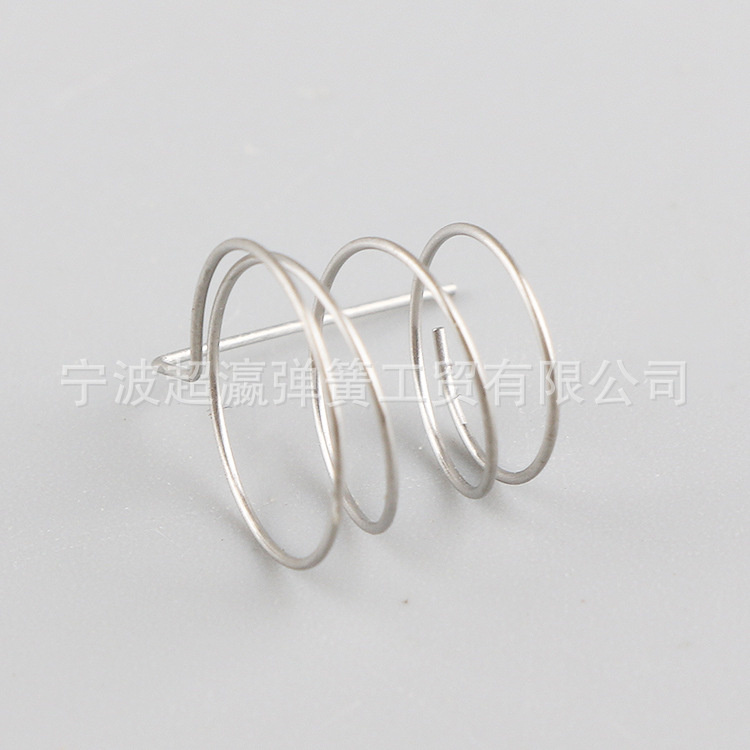
 304 Stainless Steel Small Return Pressure SpringA compact spring built for dependable cycling in valves or button assemblies, with customizable dimensions and stable performance suitable for dry or mildly humid environments.View Product →
Type 316 springs dominate marine rigging hardware, pool covers, outdoor gate hinges, salty-air door systems, chemical sprayers, washdown equipment, and any product that ships to coastal regions. If your customer's end product is exported to an island climate, the extra cost of 316 is usually justified by the warranty savings alone.
The mechanical spring rate, it is worth repeating, is nearly identical between the two grades at the same wire diameter and tensile strength. That means you can often validate a prototype in 304 and then switch to 316 for production without redesigning the spring geometry, provided the coiling parameters are adjusted for the work-hardening difference. Still, always run a production trial before committing a large order, because the heat-to-heat variation in drawn wire can be as meaningful as the grade difference itself.
Even with all the test methods described above, the best protection starts before the material reaches your factory. The mill test certificate, often abbreviated as MTC, is the official document issued by the steel mill that describes the heat number, chemical composition, and mechanical test results of the product. For full traceability, require an EN 10204 3.1 certificate or an equivalent document from your spring wire supplier. This is non-negotiable for any serious application, because it ties the physical coil to the chemistry of the melt.
When receiving spring wire or finished springs, follow a simple inspection workflow. First, compare the spool label and heat number against the MTC. Second, check the surface for stamped grade markings or painted tags. Third, run a molybdenum spot test on a sample from each coil, especially when a new batch number appears. Fourth, if the volume justifies it, use XRF to confirm the composition on the wire cross-section. Fifth, retain a small sample of each batch for future reference in case a field failure occurs later.
Five-Step Incoming Grade Verification Checklist
If the material fails a spot test or is visually suspect, quarantine the batch and contact the supplier immediately. Do not assume that the certificate protects you from a mix-up during handling at the wire mill, because mislabeled coils do occur. The cost of testing one sample is tiny compared with the cost of reworking a bad batch or paying a warranty claim after the springs are installed.
One more verification point: hardness and tensile tests do not identify the grade. If your incoming inspection only checks spring rate, free length, and wire diameter, you could receive serially drawn wire that looks and feels like stainless steel but rusts much faster. Add a chemical screening step to your quality plan, even if the test is only performed once per batch. This simple habit protects both the spring maker and the end customer.
No. Both grades look identical in most commercial finishes. Color, brightness, roughness, and surface texture depend on finishing and drawing practice, not on the grade. Always use documents, chemical tests, or XRF readings to verify the material.
No, not for wire and springs. Cold drawing and coiling transform part of the austenite into magnetic martensite, so a finished 316 spring can be clearly magnetic. The magnet test may only help separate 300-series austenitic grades from 400-series ferritic or martensitic stainless grades.
Type 316 typically costs 30 to 50 percent more than 304 per kilogram. The gap can widen for small-diameter spring wire because drawing and inventory overhead add up.
Choose 304 for indoor, dry, or mildly humid environments where chlorides are absent. Appliances, office equipment, consumer products, electronic devices, and many automotive interior applications use 304 springs successfully and economically.
Choose 316 when the spring will meet salt water, salt spray, de-icing salts, bleach, cleaning chemicals, or coastal climate. Food processing washdown, pharmaceutical cleaning rooms, marine rigging, offshore equipment, and chemical metering pumps are all typical 316 applications.
For new material, request an EN 10204 3.1 mill test certificate and keep the traceable heat number. For verifying a physical part, use a handheld XRF analyzer. For a quick field screening, use a molybdenum spot test.
Related Products
Contact us
Factory Address
No. 8, Taoyuan South Road, Wuyuqiao, Henghe Town, Cixi City, Ningbo, China
Phone
+86-188 6787 1218+86-574-62605393
QR CODE
 Wholesale Stainless Steel Coil Springs Manufacturers