English
 English
 中文简体
中文简体
 Español
 Tiếng Việt
Get in touch
English
Get in touch
Feb 23, 2026
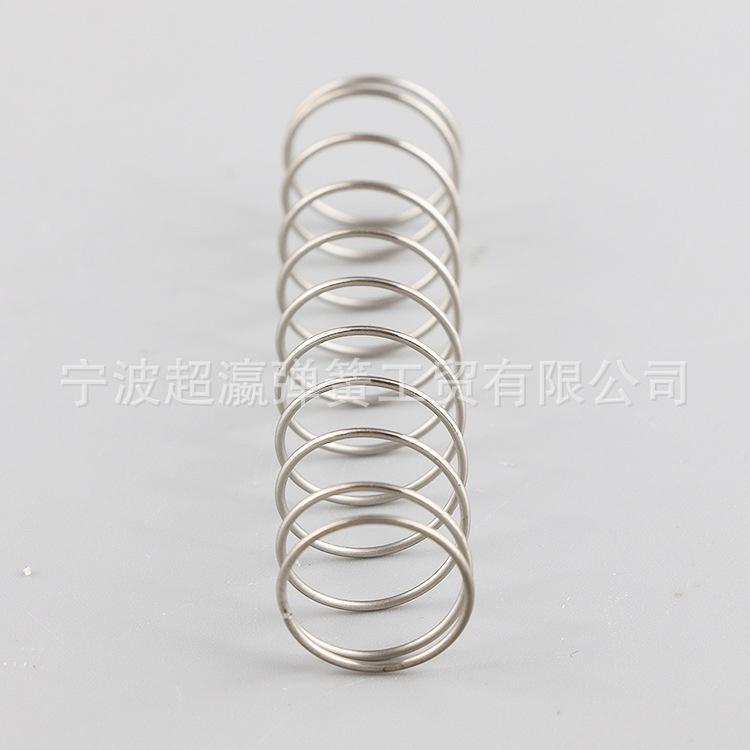
In the fields of precision machinery, automotive components, and industrial automation, Stainless Steel Compression Spring is widely used due to its excellent corrosion resistance and mechanical properties. However, under High-frequency Compression working conditions, engineers often find that springs undergo permanent deformation, elastic attenuation, or even fracture. The core trigger for this phenomenon is Thermal Fatigue.
From a thermodynamic perspective, a stainless steel spring does not undergo 100% elastic potential energy conversion during each compression and release cycle. Due to the existence of grain boundaries, dislocations, and impurities within the stainless steel material, Internal Friction is generated during movement.
Under high-frequency cycles, this internal friction converts a portion of mechanical energy into thermal energy. For carbon steel springs, thermal conductivity is relatively good, allowing heat to dissipate quickly. However, the Thermal Conductivity of austenitic stainless steel (such as AISI 304, 316) is low. This means that during continuous high-frequency operation, the heat accumulated at the center of the spring cannot be discharged in time, leading to a sharp rise in local temperature.
As the Body Temperature of the spring rises, the Modulus of Elasticity (E) and Shear Modulus (G) of the material undergo a significant decline.
For Stainless Steel, the shear modulus typically drops by about 3% to 5% for every 100°C increase in temperature. In high-frequency conditions, if heat accumulation causes the spring temperature to reach above 200°C, the originally designed Spring Rate will no longer be stable. The decrease in load capacity directly leads to Stress Relaxation, meaning the thrust output of the spring decreases under the same displacement, eventually resulting in functional failure.
In high-temperature environments, the atomic kinetic energy within the stainless steel increases, and Dislocation Glide within the crystal lattice becomes more active.
Cyclic Softening: High temperatures exacerbate the cyclic softening effect, causing a local drop in the Yield Strength of the material.
Oxidation Acceleration: Although stainless steel has a passivation layer, the protective film may suffer microscopic damage under the combined action of high-frequency vibration friction and high temperature. Accelerated oxidation in high-temperature environments makes it easier for micro-cracks to initiate at stress concentration points.
Crack Propagation: The composite stress field formed by the superposition of thermal stress and mechanical load greatly accelerates the speed at which fatigue cracks expand into the depth of the material.
Surface Condition and Stress Concentration: Surface scratches or pits formed during the drawing of stainless steel wire act as "fuses" for thermal fatigue under high-temperature and high-frequency conditions. Introducing surface compressive stress through Shot Peening is an effective means of delaying thermal fatigue cracking.
Stress Amplitude and Vibration: The larger the Stress Amplitude, the higher the heat generated by internal friction. If the spring is designed too close to the Elastic Limit of the material, the rate of thermal fatigue failure will grow exponentially.
Environmental Heat Dissipation Conditions: For a Stainless Steel Compression Spring used in closed cavities or high-temperature engine compartments, the risk of thermal fatigue is much higher than in open environments due to the lack of effective Convective Heat Transfer.
To reduce the risk of thermal fatigue in high-frequency applications, the industry typically adopts the following technical paths:
Selecting precipitation hardening stainless steel: 17-7 PH (Type 631) has better high-temperature stability and fatigue strength compared to traditional 302/304 stainless steel.
Strengthening Heat Treatment: Precisely control the Stress Relieving process to eliminate residual stresses from processing and improve grain boundary stability.
Increasing Presetting: By pre-compressing the spring to produce beneficial residual deformation, the fatigue life of the spring in subsequent high-frequency work is improved.
Surface coating technology: Use special anti-friction coatings to reduce friction heat generation between coils or between the spring and the seat hole.
Related Products
Contact us
Factory Address
No. 8, Taoyuan South Road, Wuyuqiao, Henghe Town, Cixi City, Ningbo, China
Phone
+86-188 6787 1218+86-574-62605393
QR CODE
 Wholesale Stainless Steel Coil Springs Manufacturers