English
 English
 中文简体
中文简体
 Español
 Tiếng Việt
Get in touch
English
Get in touch
Jan 12, 2026
In the precision spring manufacturing industry, many customers conduct a simple test using magnets after receiving a Stainless Steel Extension Spring. When a spring is found to have weak or even strong magnetic properties, questions regarding material quality often arise, with concerns that carbon steel or inferior materials were used. In reality, the magnetism of austenitic stainless steel springs is a complex physical evolution intimately linked to the Work Hardening mechanism.
The raw materials typically used for high-performance springs, such as Grade 304 or Grade 316, belong to the austenitic family. In a solution-annealed state, the internal microstructure of these materials is primarily Austenite. From a physical standpoint, Austenite is paramagnetic, meaning it exhibits non-magnetic or extremely weak magnetic properties. This characteristic stems from its Face-Centered Cubic (FCC) crystal structure, where the atomic arrangement prevents a significant net magnetic moment in its natural state.
A Stainless Steel Extension Spring must undergo intense Cold Working during its manufacturing cycle. As the wire is drawn to specific diameters and subsequently coiled at high force on a CNC spring former, the material undergoes significant lattice dislocation and slip.
For 304 Stainless Steel, which is a metastable austenitic grade, the mechanical stress during plastic deformation triggers a phase transformation from Austenite to Martensite. Unlike Austenite, Martensite possesses a Body-Centered Tetragonal (BCT) structure and is inherently ferromagnetic. Consequently, the deeper the degree of cold reduction, the higher the content of deformation-induced Martensite, resulting in a stronger magnetic pull from the spring.
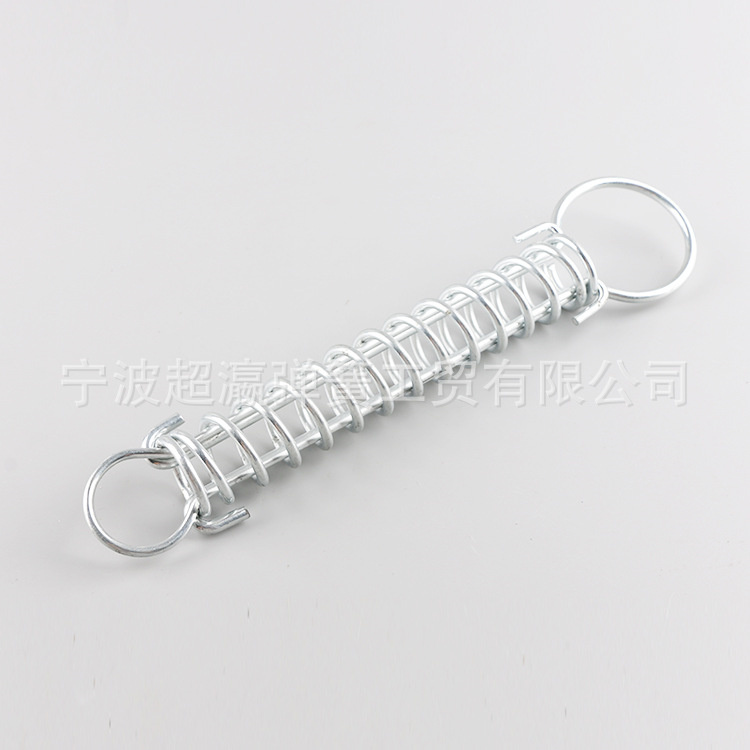
Compared to compression springs, the fabrication of a Extension Spring involves unique stress profiles. To ensure the spring maintains its necessary Initial Tension, the wire is subjected to higher torsional and tensile stresses during the coiling process.
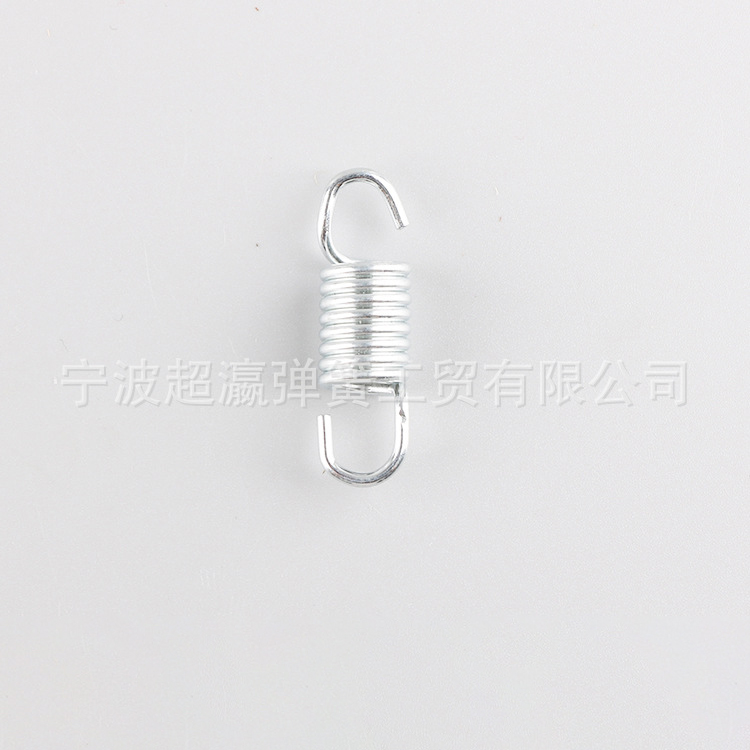
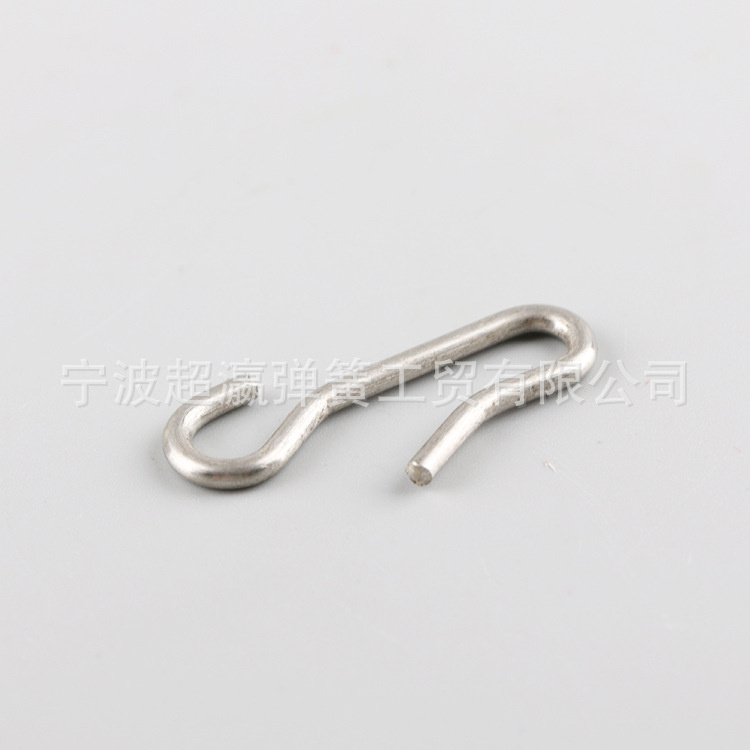
End Loops Processing: The hooks or loops at either end typically require severe bending at 90-degree angles or more. This localized extreme deformation causes the magnetic properties at the hooks to be significantly stronger than the central body of the spring.
Spring Index: A smaller Spring Index (the ratio of the mean coil diameter to the wire diameter) requires more aggressive deformation, leading to a more thorough microstructural shift and higher magnetic permeability.
A frequent topic in 304 vs 316 Stainless Steel technical comparisons is their varying magnetic response. Grade 316 contains higher levels of Nickel (Ni) and the addition of Molybdenum (Mo). Nickel serves as a powerful Austenite stabilizer, suppressing the transformation to Martensite even under mechanical stress. Therefore, a 316 Stainless Steel Extension Spring usually exhibits far less magnetism than a 304 version under identical processing conditions. This makes 316 the preferred choice for precision instruments where magnetic interference must be minimized.
Following the coiling process, springs undergo Stress Relieving to manage Internal Stress and stabilize dimensions. It is a common technical misconception that standard stress relief (typically between 250°C and 450°C) will remove magnetism. These temperatures are insufficient to revert Martensite back into Austenite.
To completely eliminate magnetism, the material would require a full solution annealing process exceeding 1000°C. However, such high temperatures would cause the spring to lose its Tensile Strength and elasticity gained through cold working, rendering the component useless for engineering applications. Therefore, in the spring industry, magnetism is accepted as a natural physical byproduct of Cold Working reinforcement.
Related Products
Contact us
Factory Address
No. 8, Taoyuan South Road, Wuyuqiao, Henghe Town, Cixi City, Ningbo, China
Phone
+86-188 6787 1218+86-574-62605393
QR CODE
 Wholesale Stainless Steel Coil Springs Manufacturers