English
 English
 中文简体
中文简体
 Español
 Tiếng Việt
Get in touch
English
Get in touch
Mar 09, 2026
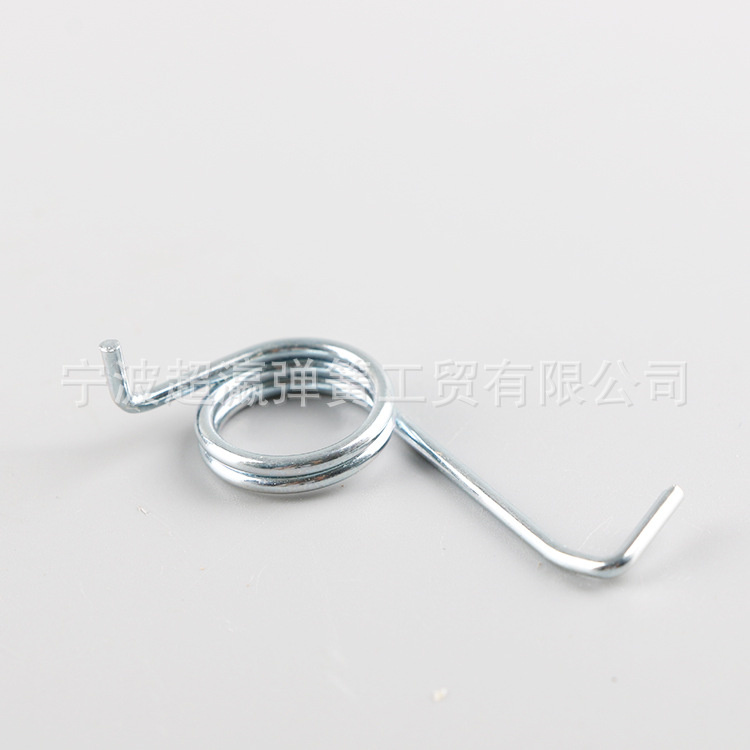
A Stainless Steel Torsion Spring is an indispensable energy storage component in precision mechanical design. Unlike compression or extension springs, its core function is to operate via torque (rotational force) around its axis. When an external force acts on the legs of the spring, it rotates around the center, converting mechanical energy into elastic potential energy.
In modern industry, the primary reason for choosing a Stainless Steel Torsion Spring is its exceptional physical properties. The stainless steel material not only provides high fatigue strength but, more importantly, offers chemical stability in harsh environments. Whether in medical devices requiring frequent disinfection or outdoor fasteners exposed to humid air, this spring ensures consistent torque output without failure due to rust or corrosion.
Its operation follows the angular version of Hooke's Law: the torque produced is directly proportional to the angle of twist. This linear output makes the Stainless Steel Torsion Spring an ideal choice for door hinges, door closers, and various reset mechanisms.
When customizing a Stainless Steel Torsion Spring, selecting the right material grade directly determines the product's lifespan and cost-effectiveness. While all are termed stainless steel, different grades vary significantly in tensile strength, corrosion resistance, and magnetic properties.
Below is a comparison of common stainless steel materials used for manufacturing a Stainless Steel Torsion Spring:
| Material Grade | Key Characteristics | Tensile Strength | Max Operating Temp | Corrosion Resistance |
| SS 302 | Most common spring steel, high strength | High | 287°C (550°F) | Good |
| SS 304 | Easy to process, food-grade safe | Medium-High | 260°C (500°F) | Good |
| SS 316 | Contains Molybdenum, extreme chloride resistance | Medium | 287°C (550°F) | Excellent (Marine Grade) |
| 17-7 PH | Precipitation-hardening, extreme strength | Very High | 343°C (650°F) | Superior |
| SS 301 | High hardness via cold working, for thin parts | Very High | 260°C (500°F) | Moderate |
Analysis Recommendations:
Environmental Factors: If the Stainless Steel Torsion Spring is used in offshore equipment or chemical labs, SS 316 is the only viable choice.
Strength Requirements: For space-constrained scenarios requiring high torque, 17-7 PH offers the highest energy density per unit volume.
Magnetic Restrictions: Although austenitic steels like 304 are non-magnetic in an annealed state, processing them into a Stainless Steel Torsion Spring creates cold-work magnetism; precision electronics may require de-magnetization.
Designing a high-performance Stainless Steel Torsion Spring requires a precise balance of geometric variables. Any minor dimensional deviation can lead to insufficient torque or premature fatigue failure.
Designers typically use the following formula to calculate the torque (M) of a Stainless Steel Torsion Spring:
M = (E * d^4 * α) / (3667 * D * n)
E: Modulus of Elasticity (approx. 190,000 MPa for stainless steel)
d: Wire diameter
α: Angle of twist
D: Mean coil diameter
n: Number of active coils
When designing a Stainless Steel Torsion Spring, the "Mandrel" (shaft) fit must be considered. As the spring is loaded (tightened), its inner diameter decreases and its length increases. If the mandrel is too large, the spring will bind on the shaft during rotation, leading to instantaneous stress overload.
The legs act as levers for the force, and their shape determines installation ease. Common configurations include:
Straight Legs: Most economical, suitable for simple clamping.
Bent Legs: Used to hook into specific mechanical slots.
Radial Legs: Legs pointing toward the center or outward for complex space constraints.
Manufacturing a Stainless Steel Torsion Spring combines metallurgy with precision machining. To ensure consistent torque and long fatigue life, the process must follow standardized steps.
Most stainless steel torsion springs are produced via cold coiling. High-precision CNC spring coilers continuously feed the wire, which is bent into pre-set coils by forming rollers and pins.
Precision Control: For a Stainless Steel Torsion Spring, wire diameter uniformity is critical. Even a 0.01mm error can cause significant torque deviations due to the fourth-power factor in the calculation.
Cold coiling induces massive internal stress. Without heat treatment, the spring would undergo plastic deformation or break quickly under load.
Temperature Control: Springs are typically stress-relieved in furnaces between 250°C and 480°C. This stabilizes the geometry and increases the elastic limit.
While stainless steel is naturally oxidation-resistant, the manufacturing process can introduce impurities.
Passivation: An acid solution removes free iron from the surface and rebuilds the chromium-oxide layer, which is key to the rust resistance of a Stainless Steel Torsion Spring.
Electropolishing: An electrochemical process that removes microscopic burrs, making the surface mirror-smooth. This eliminates stress concentration points that cause fatigue cracks.
Due to its fatigue resistance and environmental adaptability, the Stainless Steel Torsion Spring is used in core sectors requiring high reliability.
In the medical field, a Stainless Steel Torsion Spring must withstand high-pressure autoclaving without rusting.
Use Cases: Surgical clamp reset mechanisms, insulin pump dosage regulators, and dental chair support systems.
As devices shrink, the demand for miniature Stainless Steel Torsion Springs increases.
Use Cases: Laptop hinges, high-end camera shutter mechanisms, and smart door lock clutch returns.
In outdoor or corrosive industrial environments, carbon steel springs may fail within months, while a Stainless Steel Torsion Spring can last years.
Use Cases: Industrial valve actuators, automation line tensioners, and fire hydrant safety pins.
When purchasing a Stainless Steel Torsion Spring in bulk, companies must establish inspection standards to ensure consistency.
| Inspection Item | Method | Industry Standard / Target | Importance |
| Torque Test | Torque Tester | Tolerance within ±5% - 10% | Affects mechanical accuracy |
| Fatigue Test | Cycle Simulation | Meet design life (e.g., 1M cycles) | Determines early failure risk |
| Salt Spray Test | 5% NaCl Spray | SS 304 (24-48h), SS 316 (96h+) | Verifies passivation quality |
| Dimensions | Image Measurement | Strict adherence to drawings | Ensures mandrel and housing fit |
Understanding the material science behind the Stainless Steel Torsion Spring helps engineers avoid hidden design risks.
A Stainless Steel Torsion Spring is directional. It can be Left Hand or Right Hand.
Rule: The spring should always be loaded in the direction that makes its coil diameter smaller. Reversing this causes stress to spike, leading to early failure.
Identification: Hold the spring; if the leg direction matches the curl of your right-hand fingers, it is Right Hand.
Many assume stainless springs are non-magnetic. However, 302 or 304 grades used for a Stainless Steel Torsion Spring are austenitic.
Physical Change: Cold coiling transforms some austenite into martensite, creating induced magnetism.
Solution: For magnetic-sensitive applications (like MRI machines), use SS 316 with deep annealing.
The performance of a Stainless Steel Torsion Spring changes with temperature.
Impact: As temperature rises, the modulus E drops, meaning the torque output decreases for the same angle of twist. Engineers should leave a 5-10% torque margin for high-heat environments.
Q: Why did my stainless spring break suddenly despite appearing perfect?
A: Stress concentration. If the bend radius of the legs is too small (less than 1.5x wire diameter), it creates a local stress point. Also, microscopic scratches can evolve into fatigue cracks over time.
Q: Is there a strength difference between SS 304 and SS 316?
A: Yes.
SS 304: Higher tensile strength, lower cost.
SS 316: Lower tensile strength, but superior chloride/acid resistance.
Recommendation: Use 304 for strength unless the environment is highly corrosive (seawater/chemicals).
Q: How can I visually judge the quality of a Stainless Steel Torsion Spring?
A: Check for uniform coil spacing (winding stability), a clean surface without oil or rust (proper passivation), and consistent leg angles (within ±2° to ±5°).
Q: What is "Mandrel Fit"?
A: A Stainless Steel Torsion Spring usually fits over a shaft. Since the spring shrinks when tightened, the shaft diameter should be roughly 90% of the spring's inner diameter at its maximum working twist to prevent binding.
Q: Can these springs be welded?
A: Strictly No. Welding heat destroys the heat treatment of a Stainless Steel Torsion Spring, making the joint brittle or causing total loss of elasticity. Use mechanical hooks or pressure housing instead.
Related Products
Contact us
Factory Address
No. 8, Taoyuan South Road, Wuyuqiao, Henghe Town, Cixi City, Ningbo, China
Phone
+86-188 6787 1218+86-574-62605393
QR CODE
 Wholesale Stainless Steel Coil Springs Manufacturers