English
 English
 中文简体
中文简体
 Español
 Tiếng Việt
Get in touch
English
Get in touch
Mar 23, 2026
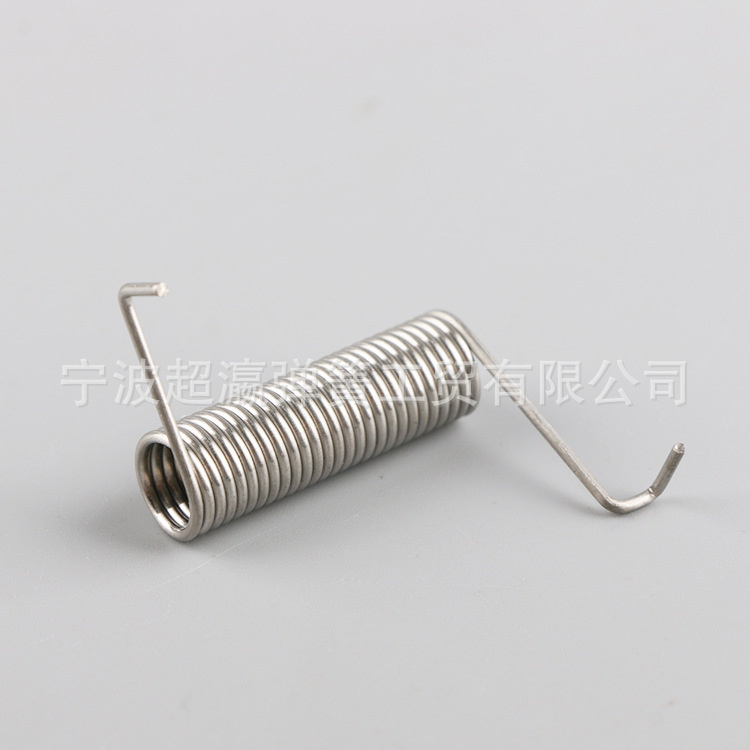
A torsion spring is one of the most fundamental and indispensable components in mechanical engineering. Unlike helical springs that generate force through extension or compression, a torsion spring operates by rotating around its axis, storing and releasing energy through torque.
The primary purpose of a torsion spring is to provide controlled resistance or power, allowing an object to rotate, maintain a specific position, or return to its original state after release.
Energy Storage and Counterbalancing: In common applications like garage doors, the torsion spring acts as a "gravity offsetter." By storing immense torque through pre-winding, it tightens when a heavy object descends and assists by releasing power during ascent, allowing heavy loads to be operated easily by hand or small motors.
Precision Positioning: In electronics (such as laptop hinges) or medical devices, Stainless Steel Torsion Springs provide constant resistance, ensuring that lids or brackets stay at any angle required by the user.
Return Functionality: In tools like scissors, clips, or automotive door handles, the torsion spring ensures that once the handle is released, the mechanism instantly returns to its initial closed or open state.
| Dimension | Torsion Spring | Extension Spring | Compression Spring |
| Force Method | Rotation/Torque | Linear Extension | Linear Compression |
| Space Utilization | Mounted around a center shaft, saves lateral space | Requires long extension travel | Requires mounting holes or guide rods |
| Energy Decay | Stable, suitable for long-path motion | Decays fast, force increases sharply at the end | Increases linearly |
| Typical Applications | Garage doors, clips, hinges | Old garage doors, trampolines | Shock absorbers, buttons, valves |
In many high-demand industrial environments, standard carbon steel springs fail due to oxidation and limited fatigue life. The Stainless Steel Torsion Spring has become the preferred choice for precision manufacturing due to its unique alloy composition.
Superior Corrosion Resistance: Stainless steel contains a high proportion of Chromium (Cr), forming a dense protective film of chromium oxide on the surface. In humid coastal areas, food processing plants, or chemical labs, ordinary springs rust and break quickly, while stainless steel versions maintain physical stability for decades.
Extreme Temperature Adaptability: In low-temperature environments, carbon steel becomes brittle in extreme cold (cold brittleness), leading to sudden bursts. Stainless steel maintains excellent toughness below zero. In high-temperature environments, a Stainless Steel Torsion Spring resists thermal relaxation, maintaining stable torque output.
Hygiene and Aesthetics: In medical devices and precision instruments, stainless steel does not produce rust debris and features a high surface finish, meeting sterile operation standards.
| Grade | Characteristics | Applications | Tensile Strength (MPa) |
| AISI 304 | Most versatile, excellent corrosion resistance and workability. | Kitchenware, industrial parts, electronic switches | Approx. 1000 - 1500 |
| AISI 316 | Includes Molybdenum for extreme resistance to chloride corrosion. | Marine environments, medical implants, chemical equipment | Approx. 1100 - 1600 |
| 17-7 PH | Precipitation-hardened, extremely high strength and fatigue resistance. | Aerospace, high-performance racing, high-frequency switches | Approx. 1600 - 2200 |
For installers or mechanical designers, the central question is "how many turns." The number of rotations directly determines the load capacity and safety of the system.
The number of turns is not determined randomly; it is based on a mathematical derivation of object weight, drum diameter, and travel height.
Using a standard garage door system as an example, the calculation usually follows this principle: Total Turns = (Door Height / Drum Circumference) + Initial Pre-tension Turns.
Standard Reference: For a standard 7-foot (approx. 2.13m) door, the spring usually requires 7.5 turns. Generally, one full turn is added for every foot of height.
Initial Tension: When the door is closed, the spring must already carry a specific initial torque; otherwise, the door will feel heavy the moment it begins to close.
Precision Tuning: If the door slides down automatically when halfway open, the turns are insufficient. If it surges upward violently, there are too many turns and pressure must be released.
Adjusting torsion spring turns is a high-risk task. Because the spring stores massive mechanical energy, if a winding bar slips or the spring breaks, the instantaneous release of rotational force can shatter bones or shear metal components.
In industrial and residential construction, the debate over whether torsion springs are safer is ongoing. From the perspective of physical structure and failure modes, torsion springs offer significant safety advantages.
Internal Support Shaft: Torsion springs are mounted on a solid steel shaft. When a Stainless Steel Torsion Spring breaks due to metal fatigue, the spring remains tightly contained on the shaft. It creates a loud bang but does not fly off or cause shrapnel injuries.
Direction of Energy Release: Torsion springs release torque (rotational force), whereas extension springs release linear projectile force. Without a safety cable, a broken extension spring can act like a multi-kilogram metal missile, causing severe property damage or personal injury.
Visible Fatigue Warning: Stainless steel has better ductility. Before a total break, it often shows subtle shape changes or "gapping," giving maintenance personnel a warning window.
Resistance to Chemical Stress Corrosion: In corrosive environments, carbon steel develops microscopic "pitting," which acts as a source of stress concentration leading to sudden snaps. A Stainless Steel Torsion Spring greatly reduces this hidden risk.
| Safety Feature | Torsion System | Extension System |
| Breakage Result | Stays on shaft, system locks up | High-speed projectile unless cabled |
| Stress Distribution | Uniform across all coils | Highest at hooks, prone to snapping |
| Balance Stability | Torque offsets, smooth operation | Uneven tension can tilt the object |
| Component Wear | Fewer contact points, even wear | Pulleys and cables wear faster |
Springs are the heart of all modern mechanical suspension systems. Understanding the 4 Types of Spring Suspension helps us see how torsional mechanics function in complex dynamic environments.
The oldest form of suspension, consisting of several layers of spring steel plates stacked together. It utilizes the elastic deformation of the plates for buffering. It features high load capacity and a simple structure; common in heavy trucks, pickups, and trailers.
The most common type found in modern passenger cars. It consists of a long strip of spring steel wound into a spiral, primarily resisting shear stress during operation. It is compact and provides excellent driving comfort, but must be paired with a shock absorber.
The most direct extension of torsion spring logic. The suspension relies on a long metal bar rather than a coil. As the wheel moves up and down, the bar twists to provide a return force. This offers extreme space savings, making it ideal for tanks and military vehicles.
[Image showing the 4 types of spring suspension: leaf, coil, torsion bar, and air]
Utilizes compressed air for elasticity instead of metal. Compressed air is pumped into a sealed container. It features adjustable stiffness and can automatically adjust vehicle height based on load; common in luxury sedans and buses.
| Suspension Type | Load Capacity | Space Occupancy | Comfort Score (1-5) | Typical Application |
| Leaf Spring | Extremely High | Large | 2 | Trucks, trailers |
| Coil Spring | Medium | Medium | 4 | Passenger cars |
| Torsion Bar | High | Minimal | 3 | Tanks, pickups, off-road |
| Air Spring | Adjustable | Large | 5 | Luxury cars, buses |
This is usually not oxidation of the spring itself but "free-iron contamination." If carbon steel tools were used during installation, tiny iron particles embed in the surface and rust. Use dedicated stainless tools or a passivation wash to maintain its finish.
Perform a balance test by opening the door halfway. If it falls quickly, torque is insufficient. If it shoots up, it is over-tensioned. Visually check for "gapping" between coils; this is a signal that a Stainless Steel Torsion Spring is reaching its yield limit.
The cost is higher due to raw materials like Nickel and Chromium, harder processing requirements, and a significantly higher lifespan (often rated for 25,000+ cycles vs. 10,000 for standard steel).
Measurements must be exact for the How many times do you turn a torsion spring calculation: measure the wire size (20 coils total length divided by 20), the inside diameter, the length across coils only, and identify the wind direction (Right-Hand or Left-Hand).
Modern cars favor coil/multi-link setups for comfort, though torsion bars remain the only choice for heavy armor like tanks where ground clearance and ruggedness are vital.
It includes an initial break-in period where torque may drop 3-5%, followed by a stable period covering 80% of the lifespan, and finally a collapse period where micro-cracks lead to rapid torque loss.
| Environment | Recommended Material | Key Characteristic |
| Dry Warehouse | Oil-Tempered Carbon Steel | Best value, simple maintenance |
| Coastal/Basement | Stainless Steel 304 | Rust-proof, high humidity resistance |
| Food/Pharma | Stainless Steel 316 | Resists chemical washdown, no debris |
| High Frequency | 17-7 PH Stainless Steel | Extreme fatigue resistance |
Related Products
Contact us
Factory Address
No. 8, Taoyuan South Road, Wuyuqiao, Henghe Town, Cixi City, Ningbo, China
Phone
+86-188 6787 1218+86-574-62605393
QR CODE
 Wholesale Stainless Steel Coil Springs Manufacturers